The Journal · Field Notes A ski lunch in the Alps isn’t a detour from the ski day. It’s half the reason you came. I read the label on everything, so this is the part of skiing I notice first. In the U.S., the food on the mountain is usually an afterthought: a tray of […]
The Journal · Field Notes
A ski lunch in the Alps isn’t a detour from the ski day. It’s half the reason you came.
I read the label on everything, so this is the part of skiing I notice first. In the U.S., the food on the mountain is usually an afterthought: a tray of something beige, priced like it’s rare, and more or less identical no matter which lift you rode to reach it. In the Alps, lunch is a reason to ski a particular mountain in the first place. The Italians will tell you there’s no such thing as bad weather, only a good excuse to sit down for a proper meal. They’re not wrong.
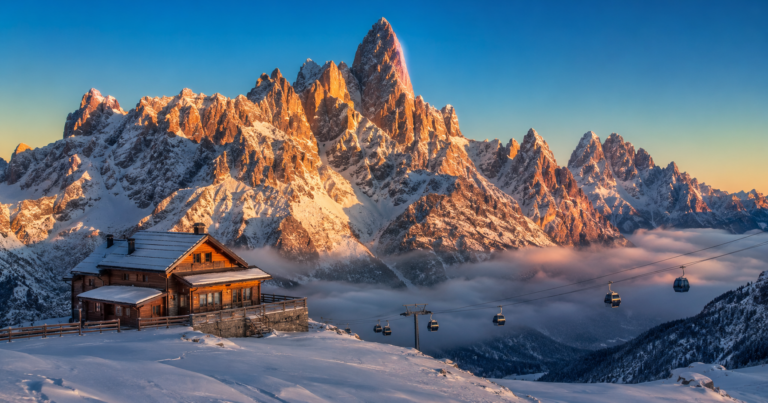
None of this is a garnish on the trip. Ski the Dolomites
for a week and you start to plan your descents around where you want to eat, not the other way around. The mountains here are a UNESCO World Heritage Site, and the cooking that happens on them is treated with the same seriousness as the terrain. What follows is a look at why the food is genuinely different, who is making it, and how to build a ski week that runs through the right kitchens.
When a single company owns an entire American resort, it tends to feed that entire resort the same way. Consolidation is the norm now: two operators, Vail Resorts and Alterra Mountain Company, control a large share of the biggest destinations, and their on-mountain dining is run centrally. The same supplier, the same menu, trucked from the base to the summit and back.
It doesn’t much matter whether you stop at the top lodge or the mid-mountain one; you meet the same food, built from whatever inputs clear the margin. The result is sameness at a premium: a burger north of twenty dollars that tastes the way it tastes everywhere else on the hill.
There are exceptions, and good ones. But the structure pushes toward the middle. A centralized kitchen is measured on cost and consistency, not on whether the speck came from the next valley over. When you standardize a menu across a whole mountain, you are optimizing for the lowest common denominator, and you can taste it by day three.
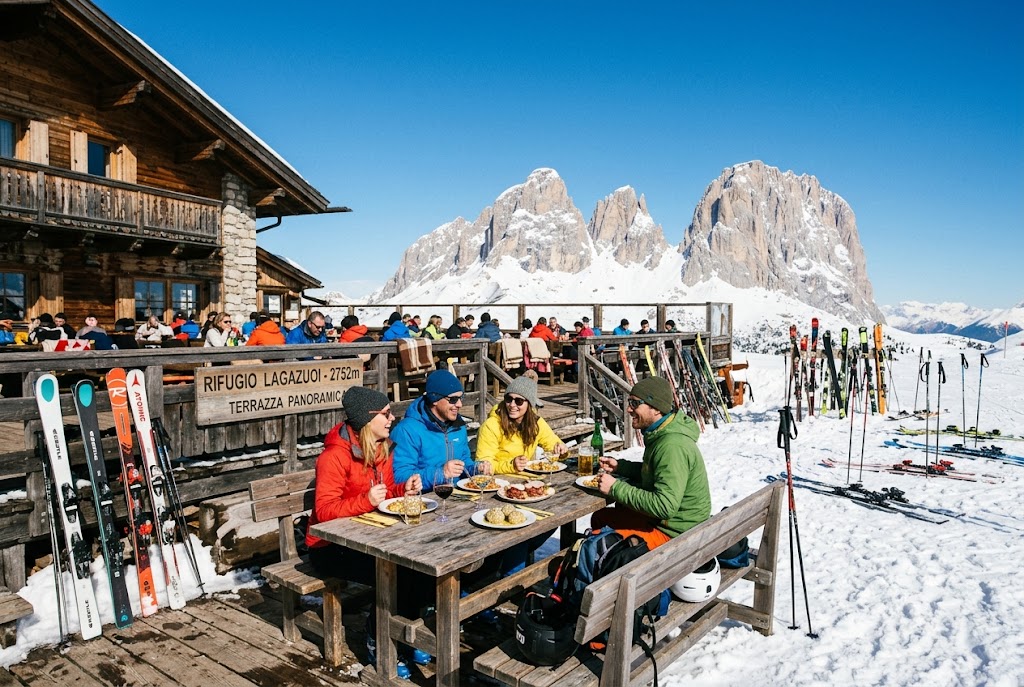
A ski lunch in the Alps rewards this patchwork. Now stand at the top of a run in the Dolomites. The ski area isn’t one company. It’s a patchwork of villages and independently run rifugios, the mountain huts that dot the pistes, most of them family businesses handed down across generations.
Rifugio Pralongìà, on the plateau above Alta Badia at roughly 2,150 metres, has been run by the same family since 1932. Lunch up there is a recipe, not a procurement contract: hand-cut canederli (the bread dumplings South Tyroleans call Knödel) in broth, speck cured a valley over, a slab of apple strudel, a plate of Ladin cajíncì you won’t find written the same way two huts apart. Ski from one kitchen to the next over an afternoon and you can taste the differences between them.
A ski lunch in the Alps is the heart of it. Because the huts compete with one another rather than answer to one central office, each has a reason to cook something worth skiing across the valley for. The region’s Ladin culture, a language and cuisine older than the borders drawn around it, shows up on the plate in dishes like turtès and cajincì that simply have no equivalent in a resort cafeteria. The ingredients tend to be local by default rather than by marketing: South Tyrolean speck carries a protected PGI designation, the cheeses come from valley dairies, and the wine often comes from a grower an hour down the road.
The best ski lunch in the Alps can be genuinely fine dining. The ceiling here is higher than most Americans expect. Each winter Alta Badia runs a season-long program, “A Taste for Skiing” (Sciare con Gusto), in which Michelin-starred chefs design signature dishes served at partner huts across the ski area, capped by the Gourmet Skisafari, an itinerant lunch on skis that moves from hut to hut.
Over on Plan de Corones (Kronplatz), AlpiNN, the mountain restaurant of three-Michelin-starred chef Norbert Niederkofler, serves his “Cook the Mountain” cuisine at around 2,275 metres, built strictly on local and seasonal ingredients. Club Moritzino, perched at 2,100 metres above Piz La Ila, has been a cult lunch stop for more than sixty years. None of this exists only as a special occasion you book months out. Much of it is just Tuesday.
Active people tend to read ingredient lists. On an Alpine mountain, the answer to “where did this come from” is usually a short one: the speck from a farm nearby, the wine from a grower in the same valley, the vegetables in season. That’s the opposite of a mega-supplier shipping the cheapest version of everything to a captive audience. After a hard week of skiing, the difference isn’t cosmetic. It’s how you feel on day five, when a real plate of protein and vegetables cooked that morning does more for your legs than another basket of fried something.
It also means you can eat well against almost any constraint. Dishes made in-house from whole ingredients are easier to adapt than a pre-packaged tray, and traceability is high enough that you can usually ask exactly where the cheese or the cured meat came from and get a real answer.
Planning a ski lunch in the Alps is half the itinerary. Knowing the mountain has good food is one thing; routing a ski day through the right kitchens is another. We live in these valleys. We know which rifugio will set a long table for twelve on a Sunday, which one does the barley soup worth skiing across the valley for, and which terrace catches the sun at exactly the hour you’ll want to stop. We also know when to book, because the best huts fill their terraces fast on a bluebird day. You ski. We’ve handled where you eat.
A ski lunch in the Alps tends to beat its American counterpart. For on-mountain dining, generally yes, and the reason is structural. Most large American resorts run their mountain restaurants centrally under one operator, which tends toward a single standardized menu. European ski areas are typically a patchwork of independently owned huts, so competition and regional cooking are built in. You’re comparing a cafeteria system to dozens of family kitchens.
A rifugio is an Alpine mountain hut, historically a shelter for hikers and climbers, now often a restaurant (and sometimes an inn) right on the pistes. In the Dolomites many are family-run and have been for generations, serving regional South Tyrolean and Ladin dishes with the peaks as the backdrop.
Yes. In areas like Alta Badia, Michelin-starred chefs partner with mountain huts each winter through programs such as “A Taste for Skiing” and the Gourmet Skisafari, and spots like AlpiNN at Plan de Corones serve serious, seasonal cuisine at altitude. You can eat a chef’s menu mid-ski-day and still get a full afternoon of runs in.
Often more so than the U.S. cafeteria model, because dishes are made in-house from regional, seasonal ingredients rather than pre-packaged. Traceability is high, so you can usually find out where the speck, cheese, or wine came from. Gluten-free and other needs are increasingly well handled; some spots, like the certified Al Passetto in Cortina d’Ampezzo, take cross-contamination seriously.
A ski lunch in the Alps is usually good value. It’s usually better value than an American resort for what you get. A sit-down hut lunch runs a fair bit less than a comparable mountain meal in Colorado or Utah, and the quality gap runs the other way. Higher-end towns and marquee huts cost more, but you’re rarely paying resort-cafeteria prices for resort-cafeteria food.
Guided by instructors who wrote the Field Guide — and at destinations they chose.