Sometime around your third $30 lunch, the math stops making sense You paid a lot for a day on the mountain. Lunch was thirty dollars a head. The rental was a hundred and change. The hotel, six minutes from the lift, cost more than a night in Manhattan. The skiing was good. That was never […]
You paid a lot for a day on the mountain. Lunch was thirty dollars a head. The rental was a hundred and change. The hotel, six minutes from the lift, cost more than a night in Manhattan.
The skiing was good. That was never the question. The question is where the money went, and why the same week in the European Alps costs so much less. Put plainly: why is skiing in Europe cheaper than the US, when the mountains are just as big and the lifts just as fast?
The answer isn’t the exchange rate, and it isn’t that Europeans care less about profit. It comes down to a single thing that almost nobody talks about: who owns the mountain.
Two companies, Vail Resorts and Alterra Mountain Company, the operators behind the Epic and Ikon passes, now sit at the center of American skiing. Between them they control the resorts most Americans have actually heard of: Vail, Breckenridge, Park City, Whistler, Palisades, Mammoth, Aspen-affiliated terrain, and dozens more.
How dominant is that grip? Vail Resorts’ own filings show that its Epic Pass products generated 65% of the company’s lift revenue and 75% of its skier visits in fiscal 2025. The season pass isn’t a side offering anymore, it is the business model.
And that model changes the economics for everyone. Season passes are sold in the spring, months before anyone knows whether it will snow. Once a skier has committed a thousand dollars up front, the resort’s revenue is locked in regardless of conditions, which is exactly why lift revenue at these companies barely moved even through a historically dry, low-snow winter. Meanwhile, the walk-up single-day ticket became a price mostly paid by people who didn’t plan a year ahead. At the marquee American resorts, that ticket now regularly clears three hundred dollars.
This isn’t a fringe complaint. In March 2026, a class-action antitrust lawsuit was filed in federal court in Colorado against Vail and Alterra, alleging the two companies’ pass strategies have pushed lift-ticket prices up across the entire industry. Whatever the outcome, the filing captures something every American skier already feels at the register.
Then there’s everything that isn’t the lift. When one company owns the mountain end to end, the lodging, the food, the rental shop, the parking, the shuttle, each of those is simply another line on the same income statement. There is no competitor at the top of the gondola.
Now cross the Atlantic.
Dolomiti Superski sells a single lift pass valid across 12 ski areas, 450 lifts, and roughly 1,200 kilometres of piste. It is, and has been for decades, the largest connected ski area on earth.
It owns none of it.
The consortium sells the pass, coordinates the marketing, and deals with local authorities. The actual infrastructure, every lift, every gondola, is run by around 130 separate member companies. Local cooperatives. Family businesses. Small operators, many of them generations deep in the same valley.
One pass. One hundred and thirty owners.
The arrangement traces back to 1974, when representatives of a dozen Dolomite valleys agreed that a skier should be able to cross the whole range on a single ticket. It was a treaty between competitors, not a merger, and more than fifty years later, it still is.
This is the structural fact that produces the price. A lift company that hikes its rate loses skiers to the next valley. A hotel that overcharges loses guests to the one across the square. No single entity captures your entire day, so no single entity can quietly inflate it.
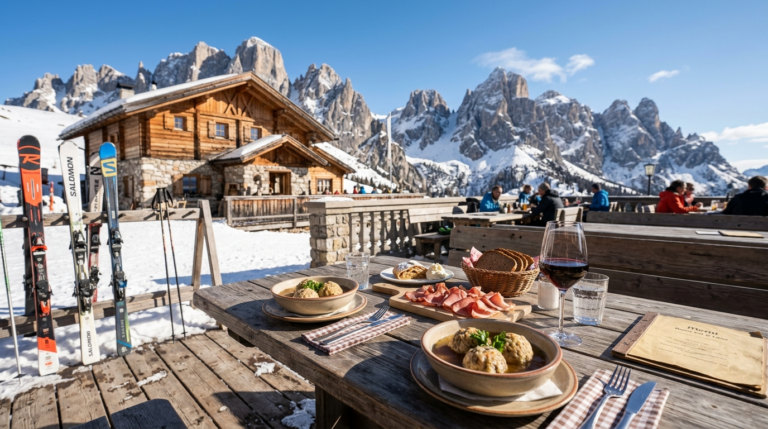
There are close to 400 mountain restaurants scattered across the slopes of Dolomiti Superski.
No one owns them.
They’re rifugi, mountain huts. In the German-speaking South Tyrol they’re hütten; in the Ladin valleys in between, the food belongs to neither Italian nor Austrian tradition and exists nowhere else on earth. Most are family-owned, many for generations. The menu changes when you ski over a pass.
It’s tempting to chalk this up to Italian culture. The real explanation is simpler: competition.
A family that owns one restaurant at 2,100 metres, whose neighbours own the next three, competes on the food, because they have to. There is no central procurement office. There is no supply contract spanning forty outlets. If today’s soup is poor, you ski somewhere else tomorrow, and they know it.
A mountain owned by a single company procures for that mountain. The ingredients arrive on the same trucks. The menu is set somewhere far from the slope. That’s not a moral failing, it’s just what integrated operations produce, and it’s why, at a consolidated resort, the food tastes about the same at the summit as it does at the base.
For a skier who trains, who reads labels, who fully intends to still be skiing at seventy, that’s not a footnote. It’s most of the day, every day of the trip.
Here’s the one that surprises most Americans.
Altitude begins to affect people above roughly 2,500 metres, and the elevation that matters most is the one you sleep at, not the one you ski at.
Breckenridge sleeps near 2,900 metres. Vail’s base sits around 2,475.
Cortina d’Ampezzo sleeps at about 1,220 metres. Selva in Val Gardena is similar. Zermatt is 1,620.
The skiing still goes high, Dolomiti Superski tops out above 3,200 metres on the Marmolada, but you descend at day’s end into a village low enough that your first night is a night of actual sleep rather than a headache, and your first morning is a morning of skiing rather than acclimatisation.
On a seven-day trip, that’s roughly a day and a half handed back to you.
Two things cut the other way, and any honest account has to name them.
Airfare. You’re crossing an ocean. Depending on the season and where you live, that’s a thousand dollars or more per person that driving to Summit County simply doesn’t cost.
Consolidation is arriving in Europe, too. Dolomiti Superski is now an Ikon Pass affiliate. The very pass economics that reshaped American skiing are being exported, and the decentralised structure described above is not guaranteed to survive the decade untouched. Part of the reason to go now is that “now” is a genuinely good time.
So an Alpine week isn’t automatically cheaper. It’s differently composed. Lift access, lodging, and food each cost a fraction of the American equivalent, per day. The flight costs more, once.
Over three days, the flight dominates and Colorado wins. Over seven, the daily costs compound and the arithmetic tips. Over ten, it isn’t close.
Understanding who owns the mountain changes what you should optimise for.
In a consolidated system, you optimise for the pass: buy in April, ski where the pass works, eat what the lodge serves.
In a fragmented system, you optimise for the route. Which hut catches the sun on the far side of the Sella at one o’clock. Which of Cortina’s lift companies runs the gondola that opens first after a storm. Which family in Alta Badia will open on a quiet Sunday for a group of fourteen.
That knowledge isn’t published anywhere. It lives with the people who are on those mountains in February and again in July, which is the entire difference between an advisor and a booking engine, and the reason this article exists.
Per day on the mountain, substantially. Lift passes, lodging, and food each cost a fraction of the equivalent at a major American resort. Airfare offsets most of that on a short trip and little of it on a long one. Around seven nights is where the total turns in favour of the Alps.
Ownership structure. In the U.S., two companies control the resorts that generate most skier visits, and their season-pass model has pushed prices up industry-wide. A single European ski area like Dolomiti Superski is run by around 130 independent operators competing under one shared pass, and competition at the level of the lift, the hotel, and the kitchen keeps every price honest.
Because roughly 400 mountain restaurants across the Dolomites are separately owned, mostly by families, and they compete for your lunch. There’s no central kitchen and no single supplier. At an integrated American resort, on-mountain dining is one department of one company.
Considerably less than in Colorado. Alpine villages typically sit between 1,200 and 1,700 metres, below the roughly 2,500-metre threshold where altitude commonly affects people, while several Colorado resort towns sleep above 2,900 metres. You still ski high in the Alps; you just don’t sleep high.
Around 130, across 450 lifts and 12 linked ski areas. The consortium sells the pass but owns none of the infrastructure.
Yes, Dolomiti Superski is an Ikon affiliate. It’s a recent development and a sign the pass model is expanding into Europe.
EuroThrills designs and guides small-group ski and cycling trips in the European Alps. If you’d like to talk through a winter trip, get in touch.
Guided by instructors who wrote the Field Guide — and at destinations they chose.